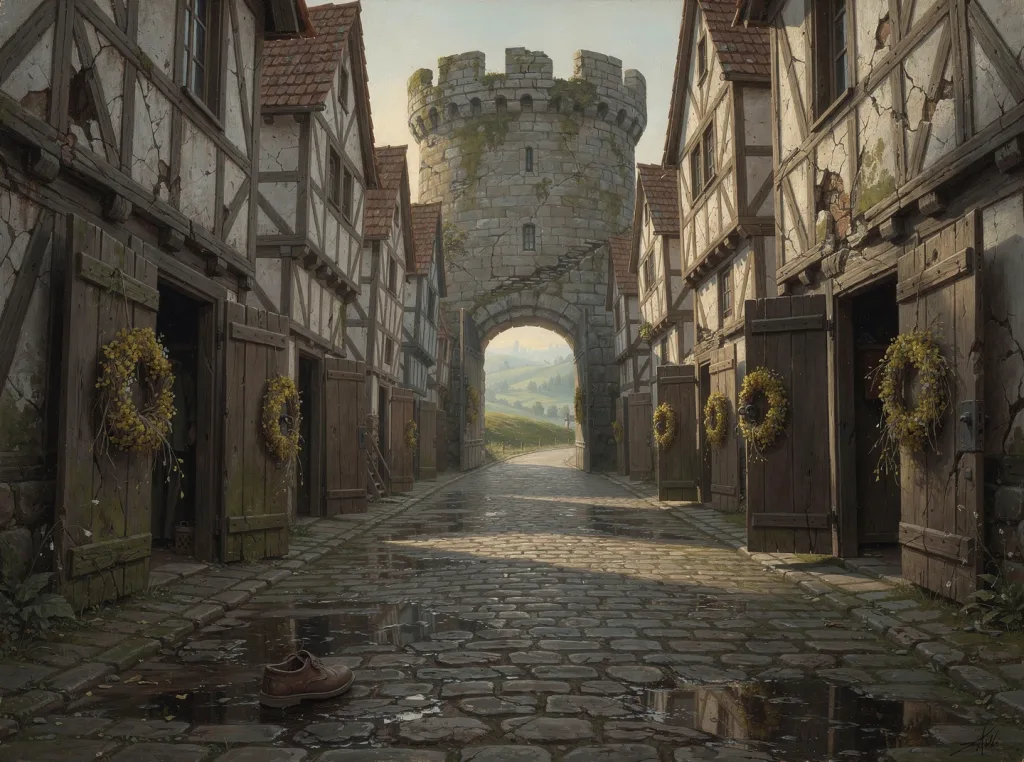
The Pied Piper of Hamelin: What Really Happened to the Children of Hamelin in 1284.
On 26 June 1284, a hundred and thirty children left the German town of Hamelin and never came back. There were no rats in the story; they were added three hundred years later.
Everyone knows the tale. Rats overrun a town, a man with a pipe appears and leads them into the river, and when the townspeople refuse to pay him he plays again, and the children follow him away.
The tale grew out of a real event. In Hamelin, a town on the Weser in Lower Saxony, children really did go missing in the summer of 1284, and the town remembered it for centuries. But the earliest records have no rats, no payment and no revenge. They have a date, a number and a man in colourful clothes.
What the sources say
The earliest evidence is a stained-glass window in Hamelin's Market Church, made around 1300, some fifteen years after the event. It showed a man in pied clothing and children in white. The window was destroyed in 1660, but several people described it before then.
The fullest account is a mid-fifteenth-century manuscript kept in Lüneburg: “In the year of 1284, on the day of Saints John and Paul, on the 26th of June, 130 children born in Hamelin were seduced by a piper, dressed in many kinds of colours, and lost at the place of execution near the Koppen.” The Koppen is a hill just east of the town.
Hamelin's town chronicle, in an entry of 1384, opens with the words: “It is a hundred years since our children left.” For a time the town even dated events from that day.
And in the old town there is still the Bungelosenstrasse, the “street without drums”. Tradition says the children were last seen walking down it, and music is forbidden there: even a wedding procession falls silent as it passes through.
Where the rats came from
The rats, the plague and the rat-catcher cheated of his fee appear only in the mid-sixteenth century, three hundred years after the event. Most likely a separate wandering tale, about a catcher who drives out rats, was grafted onto the old story of the lost children.
The story became world-famous in its new form: the Brothers Grimm published it in 1816, and Robert Browning turned it into a poem in 1842. So the thirteenth century came to speak in the language of a fairy tale, and a dry line about a hundred and thirty children became a parable about an unpaid debt.
What historians think
Seven centuries have produced many explanations, and each has a weak spot.
Disease or plague. Against: the sources say nothing about deaths, and towns do not date their years from an epidemic or ban music on a single street because of one.
An accident: the children drowned in the Weser, sank into a bog, or died in a landslide by the hill. Against: there is not a word about bodies or burials, and “lost” is not “died”.
Dancing mania. Such outbreaks are known in medieval Europe: people began to dance and followed the music until they collapsed. Against: the manuscript mentions no dancing, only a piper and a route to a particular place.
A children's crusade or pilgrimage. Against: the famous Children's Crusade was seventy years earlier, and no crusade was being raised in 1284.
The Battle of Sedemünde in 1260, where many young men of Hamelin were killed. Against: the date is wrong, and the children in the story left rather than fell.
Emigration to the east. In the thirteenth century Germans moved in large numbers to new lands beyond the Elbe, in Brandenburg, Pomerania and Moravia, and professional recruiters, locators, signed up the settlers. Researchers find place names and surnames in those regions that resemble ones from Hamelin, and medieval texts often call young townspeople “children”. Against: if they left of their own accord, why did the town remember it as a loss for centuries?
But a question remains
No theory explains everything. And in every one of them there is a detail the sources pass over in silence.
The gates of a medieval town were locked at night. A hundred and thirty people went out through them at dawn, so someone opened those gates. Someone saw them leave, someone knew where the road beyond the hill led. The town remembered the man in pied clothes. It did not remember the others, or chose not to.
This article does not reveal the solution to the investigation