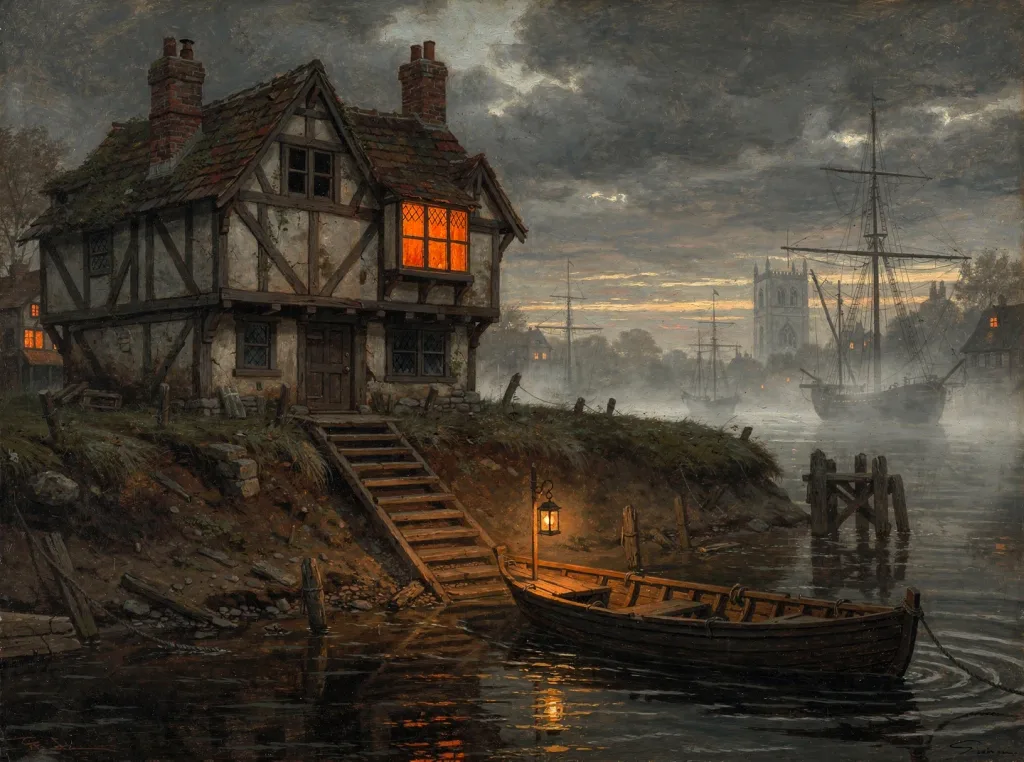
The Death of Christopher Marlowe: What Happened at Deptford on 30 May 1593.
On the evening of 30 May 1593, in a house by the Thames, England's most famous playwright was killed by a dagger blow above the eye. Three witnesses said it was a quarrel over the bill. For more than three hundred years nobody knew even that much.
Christopher Marlowe was born in Canterbury in 1564, the same year as Shakespeare, the son of a shoemaker. A scholarship took him to Cambridge, and he left it not as a clergyman, as a scholarship boy was expected to, but as the author of Tamburlaine, The Jew of Malta, Edward II and Doctor Faustus. At twenty-three he changed the English stage: before him blank verse was a rarity there; after him no one could write any other way.
He was twenty-nine when he died. For three centuries his death was known only through rumour: one writer said he was stabbed by a serving-man in a brawl, another that a rival in love killed him, a third that God struck down the atheist with his own dagger. The actual inquest was found in the archives only in 1925, by the American scholar Leslie Hotson, and since then the questions have multiplied rather than diminished.
What the inquest records
At ten in the morning on 30 May 1593, four men met at the house of the widow Eleanor Bull in Deptford, the shipbuilding suburb of London: Christopher Marlowe, Ingram Frizer, Nicholas Skeres and Robert Poley. They dined, walked in the garden, had supper, and spent the whole day together.
Around six in the evening, the coroner wrote, Marlowe and Frizer fell out over the payment of the bill, “le recknynge”. Marlowe was lying on a bed; Frizer sat with his back to him at the table, between Skeres and Poley. Marlowe snatched Frizer's dagger from his belt and gave him two wounds on the head, each two inches long. Frizer, hemmed in between his companions, wrestled for the dagger and struck Marlowe above the right eye, a wound two inches deep and one inch wide. Death was instant.
Because the house lay within twelve miles of the Queen's person, within the verge, the inquest was held not by the local coroner but by the Coroner of the Queen's Household, William Danby. On 1 June sixteen jurors heard the three witnesses and returned a finding of self-defence. That same day the body was buried in an unmarked grave in the churchyard of St Nicholas. The parish clerk got the killer's name wrong, recording him as “ffrancis Archer”. Four weeks later, on 28 June, Frizer received a royal pardon.
Spring 1593
In the month before, London had been hunting for culprits. On 5 May verses threatening foreigners appeared on the wall of the Dutch Church, signed “Tamburlaine”, the name of Marlowe's hero. The Privy Council ordered the arrest and search of anyone suspected of writing them.
On 12 May the playwright Thomas Kyd, who had once shared a room with Marlowe, was arrested. Among his papers was a heretical tract. Kyd was tortured, and said the papers were Marlowe's and had become mixed up with his own when they were writing in the same room. On 18 May a warrant was issued for Marlowe's arrest; on 20 May he appeared before the Council and was ordered to report daily until called again.
In those same days the Council received a note from the informer Richard Baines. In it Marlowe is reported as saying that Moses was a juggler, that religion was invented to keep men in awe, that Christ loved St John with an unnatural love, and that all they that love not tobacco and boys were fools. Any one of these could carry a death sentence. Marlowe was killed before he could be examined.
Three men at the table
In time historians established who the witnesses were, and that changed everything.
Robert Poley was a secret service agent, the man who in 1586 won the trust of the Babington plotters and sent them to the scaffold. In May 1593 he was carrying dispatches from The Hague, and the Treasury paid him for the whole period from 8 May to 8 June as time spent “in her Majesty's service”. That included the day at Deptford.
Nicholas Skeres was a confidence man who swindled young heirs out of their money, and on the side ran errands for the same secret service.
Ingram Frizer was a business agent of Thomas Walsingham, cousin of the late spymaster Sir Francis Walsingham. Marlowe had been staying at Thomas Walsingham's house at Scadbury in the spring of 1593, and it was there the Council's messenger found him. After his pardon Frizer returned to his master and served him and his wife for the rest of his life.
Even the house was no accident. Eleanor Bull was related to Blanche Parry, the Queen's closest gentlewoman, and what she kept was not a tavern but a house where one could eat and talk without being overheard. Four men tied to intelligence work spent ten hours together in a private house, and three of them told the same story.
What historians think
A simple quarrel. Marlowe had a temper: he had been involved in the fatal fight in Hog Lane in 1589 and had been bound over for threatening constables in Shoreditch. Against: three witnesses who knew more about interrogations than any coroner gave matching accounts of a blow above the eye that is very hard to deliver to a man lying behind you who has hold of your arm.
A killing ordered by Thomas Walsingham, whom Marlowe under torture would have named first. Against: Walsingham was his patron and friend, and no direct evidence against him has ever been found.
Court factions. The Earl of Essex wanted to strike at the circle of Sir Walter Ralegh, where Marlowe was said to have aired his freethinking views; the Cecils needed a man who knew too much about secret service business to stay silent. Against: no letter and no payment for such work has ever been found.
A faked death. Marlowe was not killed but spirited abroad, and someone else was put in the grave; this guess is the root of the theory that Marlowe wrote Shakespeare's plays. Against: there is no evidence for it, and Shakespeare's first poem, Venus and Adonis, was registered six weeks before Deptford.
But a question remains
Everything in the inquest fits together, and that is its weakness. Three professional liars tell the story in the same words, the body is buried on the day of the inquest, the killer is pardoned within four weeks and goes back to his employer, and no record of that evening exists apart from their own words.
Some six years later Shakespeare gave his clown Touchstone the line that when a man's good wit is not understood, “it strikes a man more dead than a great reckoning in a little room”. The audience knew which room he meant. We know who struck the blow. We still do not know why the four men came to that house.
This article does not reveal the solution to the investigation